


Uncategorized
Licence to Drive a Van in Singapore: Class 3A vs 3C (2026)
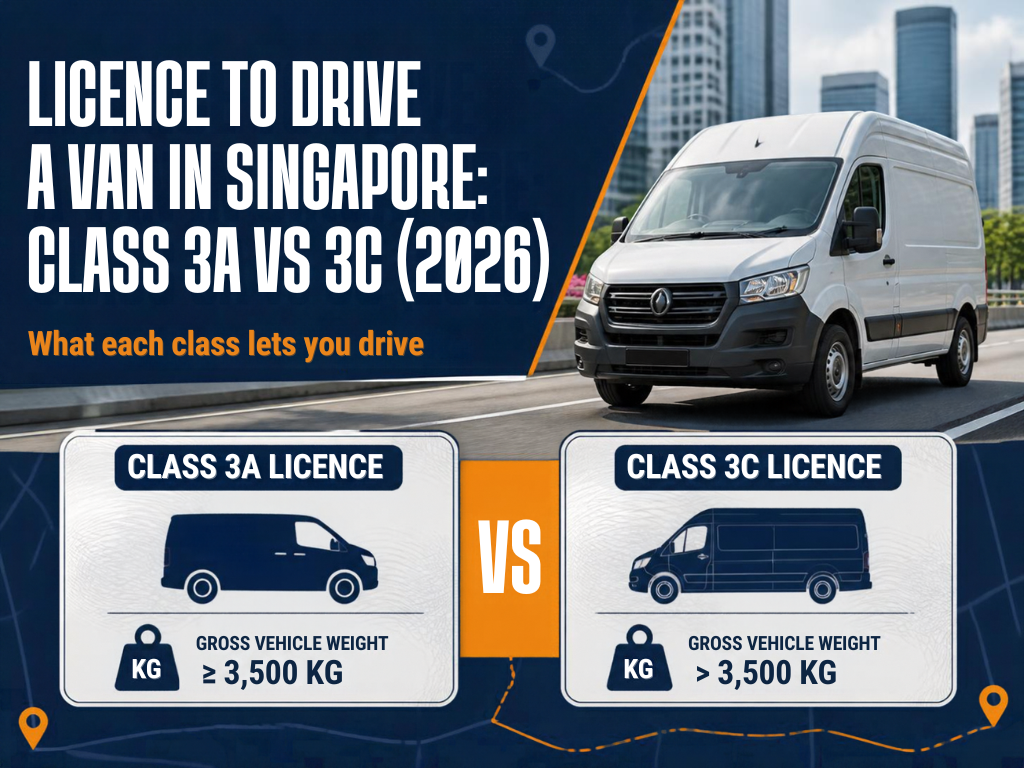
The licence to drive a van in Singapore is Class 3 or Class 3A, and the van must weigh no more than 2,500 kg unladen, or 3,000 kg if it’s electric. On a Class 3C licence, you can’t drive a van at all. Here is how each licence class works, and what C&P Rent-A-Car checks before handing over a van through its Singapore self-drive and chauffeur services.
Which licence do you need to drive a van in Singapore?
You need a Singapore Class 3 or Class 3A driving licence. If the van runs on diesel or petrol, it must weigh no more than 2,500 kg unladen. Any van or bus built to carry goods or passengers above that weight needs Class 4.
The Traffic Police licence table, updated on 15 June 2026, splits Class 3 into four vehicle groups. Motor cars qualify up to 3,000 kg unladen, with no more than seven passengers excluding the driver. Light goods vehicles, small buses and other motor vehicles qualify up to 2,500 kg. Electric light goods vehicles and electric small buses get 3,000 kg, and so do ambulances, with a seven-passenger cap.
There are two weights to keep apart. LTA classifies a goods vehicle by maximum laden weight, and anything up to 3,500 kg fully loaded counts as a light goods vehicle. Traffic Police licenses the same van by its unladen weight, meaning the vehicle empty. Your licence goes by the second number.
Every self-drive van at C&P Rent-A-Car, including the 13-seat Toyota Hiace High Roof Commuter, is hired on a Class 3 or 3A licence. Our guide to car rental in Singapore covers the rest of the hire process.
Can a Class 3A licence holder drive a van?
Yes, as long as the van is automatic. Class 3A covers the same vehicles and the same 2,500 kg and 3,000 kg limits as Class 3, but only vehicles built without a clutch pedal.
So check the gearbox. In C&P’s fleet, the Nissan NV200 is manual only, which rules it out for a Class 3A holder. The Citroen Berlingo L2, Peugeot Partner LWB, Toyota Hiace High Roof Van, Renault Master and both Hiace commuters are automatic. The Nissan NV350 and Toyota Hiace Standard Roof Van come in both.
This is easy to get wrong when you book. If you hold Class 3A and reserve “an NV350” without naming the gearbox, you’ve booked a model that also comes in manual. Ask for automatic, in writing, at the time of booking.
The same split applies to heavier vehicles. Traffic Police now issues Class 4P, the automatic-only version of Class 4, for vehicles above 2,500 kg unladen. A driver who learns on an automatic lorry stays on automatic vehicles.
Can you drive a van with a Class 3C licence?
No. Class 3C covers motor cars only, up to 3,000 kg unladen with seven passengers or fewer. Vans, pick-ups, mini vans and small buses all fall outside it, however light they are. Class 3CA is the automatic-only version, with the same limits.
Work Permit and S Pass holders get Class 3C when they convert a foreign licence by passing only the Basic Theory Test. The Singapore Police Force states in its guidance on Singapore driving licence classes that these drivers need Class 3 or 3A to drive light goods vehicles, small buses and mini vans for work. Anyone driving for work must also hold a Singapore licence within six months of their work pass being issued.
To upgrade, a 3C holder takes the Traffic Police Practical Driving Test on top of the Basic Theory Test. Bukit Batok Driving Centre runs a Class 3C and 3CA upgrading course for this. Since 15 September 2025, a 3C holder who wants Class 4 lessons must first pass a road assessment. Fail it, and the 3C licence is revoked.
If you employ drivers, check the class on each worker’s Digital Driving Licence before their first delivery run.
What does unladen weight mean, and when do you need Class 4?
Unladen weight is what the vehicle weighs empty, with no cargo or passengers. A diesel or petrol goods vehicle or bus above 2,500 kg unladen needs a Class 4 or Class 4P licence.
LTA sorts goods vehicles into three bands by maximum laden weight: light goods vehicles up to 3,500 kg, heavy goods vehicles from 3,501 kg to 16,000 kg, and very heavy goods vehicles above 16,000 kg. The licence line is a different number: 2,500 kg empty. To see whether a van or lorry is under it, look at the unladen weight on its log card. Its length and badge won’t tell you.
You can only apply for Class 4 while holding a valid Class 3 or 3C licence, so every lorry driver in Singapore starts on a car licence first.
Once the van is loaded, a different rule applies. Carrying more than the maximum laden weight is an offence, whatever licence the driver holds. C&P publishes a payload for each van, such as 1,220 kg for the Toyota Hiace High Roof Van and 1,440 kg for the Nissan NV350, so you can plan the load before you pick up.
Can you drive an electric van on a Class 3 licence?
Yes, up to 3,000 kg unladen. That’s 500 kg more than the limit for a diesel or petrol van, and Traffic Police raised it because batteries add weight without making the van harder to handle.
In its December 2025 notice on electric light goods vehicles, Traffic Police said electric light goods vehicles and electric small buses weigh 400 to 500 kg more than their combustion equivalents, and the battery under the floor lowers the centre of gravity. From 15 December 2025, an exemption order let Class 3 and 3A holders drive named models between 2,501 kg and 3,000 kg. The June 2026 licence table now lists every electric light goods vehicle and electric small bus up to 3,000 kg under Class 3 and 3A.
For combustion vans, the limit is still 2,500 kg. So a diesel Hiace and an electric van of the same size can sit in different licence classes.
C&P’s 2025 EV van guide lists two models. The BYD T3 has a 780 kg payload and an estimated 300 km range. The Volkswagen ID. Buzz Cargo carries 770 kg and has a 461 km range. If you’re moving a fleet to electric, ask about both through C&P’s long-term van leasing.
Can a Class 3 licence holder drive a 13-seater minibus?
Yes, if it’s a small bus of no more than 2,500 kg unladen, or 3,000 kg if electric. The seven-passenger cap in Class 3 is for motor cars. The Traffic Police table puts small buses in a separate group.
So a Class 3 holder can drive C&P’s 11-seat Toyota Hiace Standard Roof Commuter and 13-seat Toyota Hiace High Roof Commuter. A Class 3C holder can’t, because Class 3C only has the seven-passenger motor car group.
Bigger groups need bigger buses, and those need a different licence. A coach-built minibus such as the 22-seat Toyota Coaster weighs well above 2,500 kg empty, which puts it in Class 4. For a family day out, church group or company offsite of more than 13 people, a chauffeured minibus or coach means no one in the group has to drive. Our piece on the benefits of minibus rental compares the options for larger groups.
Can a foreigner rent a van in Singapore with a foreign driving licence?
Yes, if you’ve lived in Singapore for less than 12 months and your foreign licence covers the vehicle. You’ll also need an International Driving Permit or an official English translation, unless you hold an ASEAN licence.
The longer you stay, the stricter it gets. The Singapore Police Force requires conversion to a Singapore licence for foreigners resident more than 12 months, and for Work Permit and S Pass holders employed as drivers. New citizens and permanent residents get three months on their foreign licence before they have to convert. C&P’s FAQ asks Employment Pass holders to convert within their first year on the pass.
Watch out for the converted Class 3C. It looks like a full Singapore licence and lets you drive a car legally, but it covers no van in any rental fleet.
At the C&P counter, foreign hirers show a driving licence plus a passport or Employment Pass. C&P requires at least one year of qualified driving experience. Residents show an NRIC and a Singapore licence.
Can P plate drivers rent a van in Singapore?
The law lets a P plate driver with Class 3 or 3A drive a van. C&P won’t rent one to them. That limit comes from the rental company, so the answer changes from one company to the next.
Every new Class 3, 3A, 3C and 3CA driver displays a P plate for a one-year probation period, according to the Traffic Police Basic Theory of Driving handbook. Within Class 3, Traffic Police sets no separate limit for new drivers. In a written parliamentary reply in March 2021, Minister for Home Affairs K Shanmugam said there is “no evidence that new drivers will not be able to handle” Class 3 vehicles.
C&P sets its own bar. Hirers must be 23 to 65 years old with more than one year of driving experience, so drivers with only one year are turned away. The age cap follows the law. A Class 3 licence stops being valid at 65 unless a doctor certifies the holder fit to drive, and that check repeats every three years.
Which rules change once you are driving a van?
Drive a panel van and goods-vehicle rules apply: a 70 km/h speed limit, a speed warning device and a legal cap on load. Lorries above 3,500 kg maximum laden weight are limited to 60 km/h.
Traffic Police requires goods vehicles up to 3,500 kg maximum laden weight to carry a speed warning device. Overloading beyond the maximum laden weight and failing to secure a load each carry, for a first offence, a fine of up to $1,000, up to three months’ jail, or both.
Traffic Police and LTA do check. In a three-day operation from 18 to 20 August 2025, they stopped 166 commercial vehicles, issued 121 summonses and found 93 LTA-related violations. Seven of those were overloaded vehicles.
If you’re renting, these fines are yours. C&P bills parking and traffic infringements to the hirer, so if the van goes through a speed camera at 80 km/h, the fine lands on your account.
What should you check before you rent a van?
Before you pay, check your licence class, the van’s gearbox and your driving experience against the rental company’s rules. If any one of them doesn’t match, the booking ends at the counter.
| Check | Where to find it | What passes |
| Licence class | Digital Driving Licence in the Singpass app | Class 3 or 3A. Class 3C and 3CA fail for any van |
| Gearbox | Booking confirmation | Automatic if you hold Class 3A |
| Unladen weight | Vehicle log card, or ask the rental company | 2,500 kg or less (3,000 kg if electric) |
| Driving experience | Licence issue date | More than one year at C&P |
| Age | NRIC or passport | 23 to 65 at C&P |
| Residency | Pass or passport entry stamp | Under 12 months on a foreign licence, or a converted Singapore licence |
Bring the Singpass app itself. The Singapore Police Force tells businesses to verify the Digital Driving Licence inside the app and not to accept screenshots. If you hold Class 3C and fail the first row, you can still move goods or guests the same day with a C&P driver behind the wheel.
Our checklist for choosing a rental company and guide to picking the right rental van cover the rest of the booking.
What should you remember before booking a van?
The licence class on your card decides which van you can take. Class 3 and 3A cover every van in C&P’s self-drive fleet, with 3A limited to automatics. A converted 3C covers none of them. Electric vans now get a 3,000 kg allowance that diesel vans don’t, and rental companies add their own experience and age rules on top of the law.
Check the gearbox and seat count against your licence, then book a C&P self-drive van. If you hold Class 3C, call +65 6736 6666 to book a van with a C&P chauffeur.
Frequently asked questions
How long is the P plate period in Singapore?
The P plate period in Singapore lasts one year from the date a new Class 3, 3A, 3C or 3CA licence is granted, according to the Traffic Police Basic Theory of Driving handbook. P plate drivers may legally drive a van on Class 3 or 3A, but C&P Rent-A-Car requires more than one year of driving experience.
Can I drive a van in Singapore with a Malaysian licence?
Yes, if you’ve lived in Singapore for under 12 months and your Malaysian licence covers the vehicle. Malaysia is in ASEAN, so you don’t need an International Driving Permit. After 12 months’ residency, the Singapore Police Force requires conversion. Work Permit or S Pass holders who convert get Class 3C, which excludes vans.
Do I need to carry my driving licence when driving a van?
No. Singapore law doesn’t require you to carry a licence while driving, and the Digital Driving Licence in the Singpass app shows your classes if Traffic Police stop you. Rental companies still check it at handover. C&P Rent-A-Car asks for a licence plus an NRIC, passport or Employment Pass.
Can a Class 3 licence drive a lorry in Singapore?
Yes, if the lorry weighs no more than 2,500 kg unladen. Traffic Police places heavier goods vehicles in Class 4, which covers vehicles built to carry a load above that weight. Check the unladen weight on the vehicle log card before driving any lorry on a Class 3 licence.
Can I rent a van if I am over 65 in Singapore?
Not at C&P Rent-A-Car, which caps hirers at 65 years old. Singapore law lets Class 3 holders keep driving past 65 only if a registered doctor certifies them fit, and the check repeats every three years. If you’re over 65 and need a van for a move, you can book one with a C&P chauffeur instead.